 Ember Lotus
Back to Guided Sound
Why I Begin
With Noise
Most people aren’t arriving from silence. They’re coming from work, traffic, and everything else happening in their lives.
I begin my group sessions with everyday street noise, then gradually let it recede. I want people to notice the sound they usually tune out.
Start with your device volume low. The opening can feel intense; stop or skip it whenever you need. Don’t listen while driving.
Sound is off.
Continue without audioRead the opening audio description
- 0:00–0:05
- A partially audible elevator announcement overlaps with a brief breath sound.
- 0:05–0:10
- An elevator chime and the sound of its doors overlap with crowd chatter.
- 0:10–1:05
- Overlapping crowd voices fill the soundscape. Individual words are indistinct. Low tones become more prominent as the crowd fades.
- 1:05–1:30
- Low pulses and sustained tones continue until the excerpt ends.

We get so used to the noise around us that we stop paying attention to it. Beginning here gives the quieter passages a frame of reference.
After listening, notice one sound around you that you had stopped hearing.
The intention behind the sound
Sound Is a Stepping
Stone to Silence.

I don’t begin by asking people to be quiet inside. I begin with the noise.
Removing the outside noise doesn’t necessarily quiet what’s happening within us. Sometimes it makes it more noticeable.
In the wordless passages, sound gives us somewhere to place our attention without telling us what to think. As it changes and falls away, my intention is to give us time to meet the quiet—not ask us to arrive there all at once.
For me, that space is where reflection begins: noticing what I’m feeling, sitting with it, and imagining a way forward that I couldn’t see while everything felt crowded.
The spoken passages offer guidance. The sound itself leaves room for us to explore what comes up in our own way.
From the opening into breath & rhythm
The Breath Enters
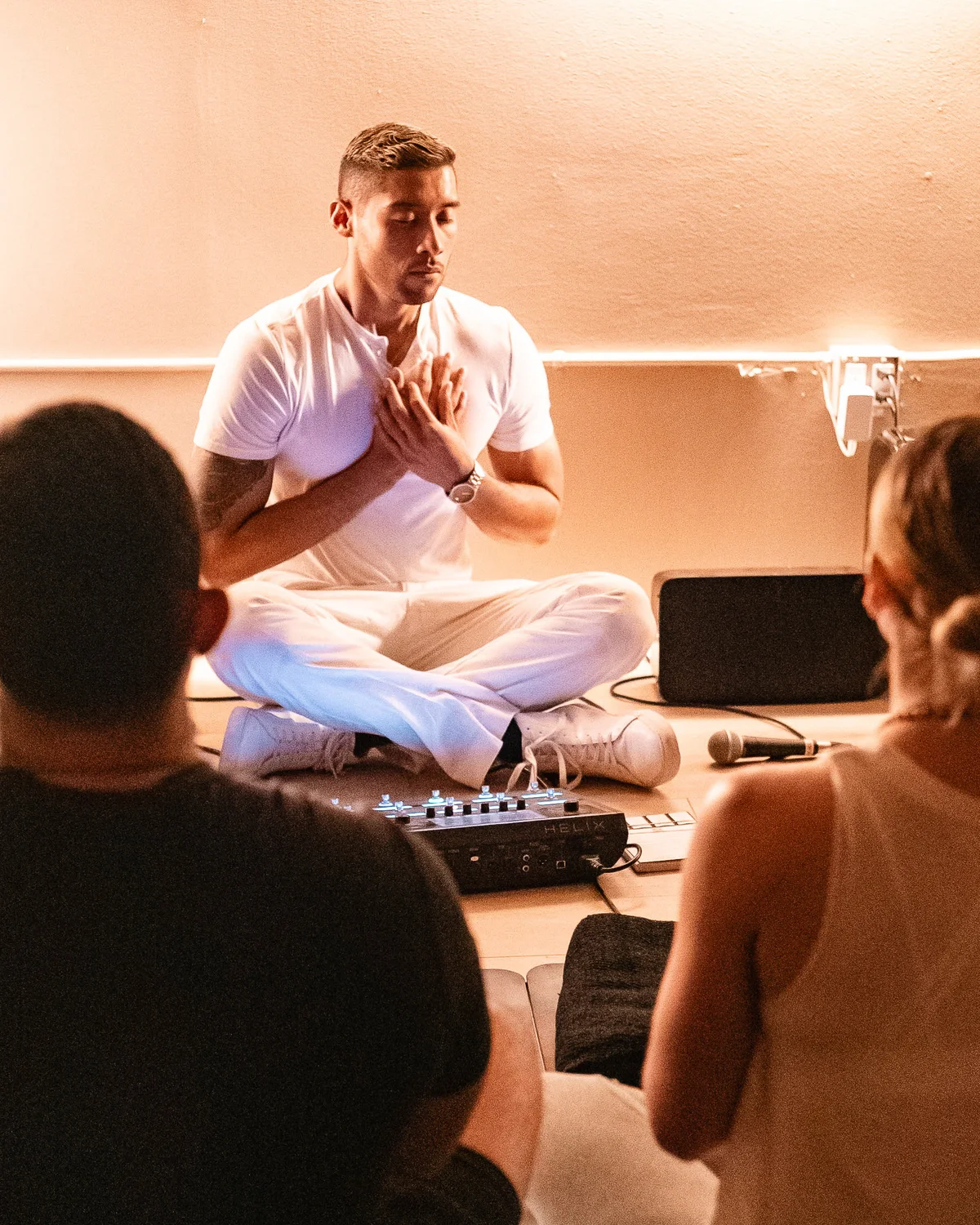
As the everyday noise fades, you start to hear a breath. A steady, plucked tone comes in alongside it. I use that repeating sound to offer a pace for breathing.
The breathwork continues with the pulse. After that passage, a sustained tone remains for a while. We haven’t reached silence yet.
You can follow the cue if it feels comfortable, or keep breathing at your own pace.
More About the Tones
The short plucked sound gives you a rhythm you can hear directly. I use that repeating pulse as an optional cue during the breathing passage. You can follow it for a few breaths and return to your own pace whenever you like.
The binaural layer works differently. With separate tones reaching the left and right ears, you may hear a beat produced by the difference between them. Ordinary room speakers let the two channels mix in the room, so the same recording can sound different there.
The 90-second opening lets you hear how the sound begins to change. The essay follows the broader arc of a live group session.
Following the sound
A Rhythm to
Come Back To.
I use the repeating tone to give people something simple to follow as their attention moves from the noise around them to their own breathing.
Hear the repeating pluck. Let it offer a pace.
Rest a hand on your belly. Let it move gently, without forcing the breath.
Listen Breathe Return
Follow the cue if it feels comfortable, or keep your own rhythm.
03 / Inner-child reflection
Then, Two Voices.
A little girl and a little boy speak to one another about love, innocence and remembering.
I place their conversation here because I want to bring us back to a part of ourselves that can be easy to lose touch with. Before we start exploring what’s possible, we spend a little time with that younger part of ourselves.
You don’t have to bring up a memory. You can simply listen, or let this part pass.


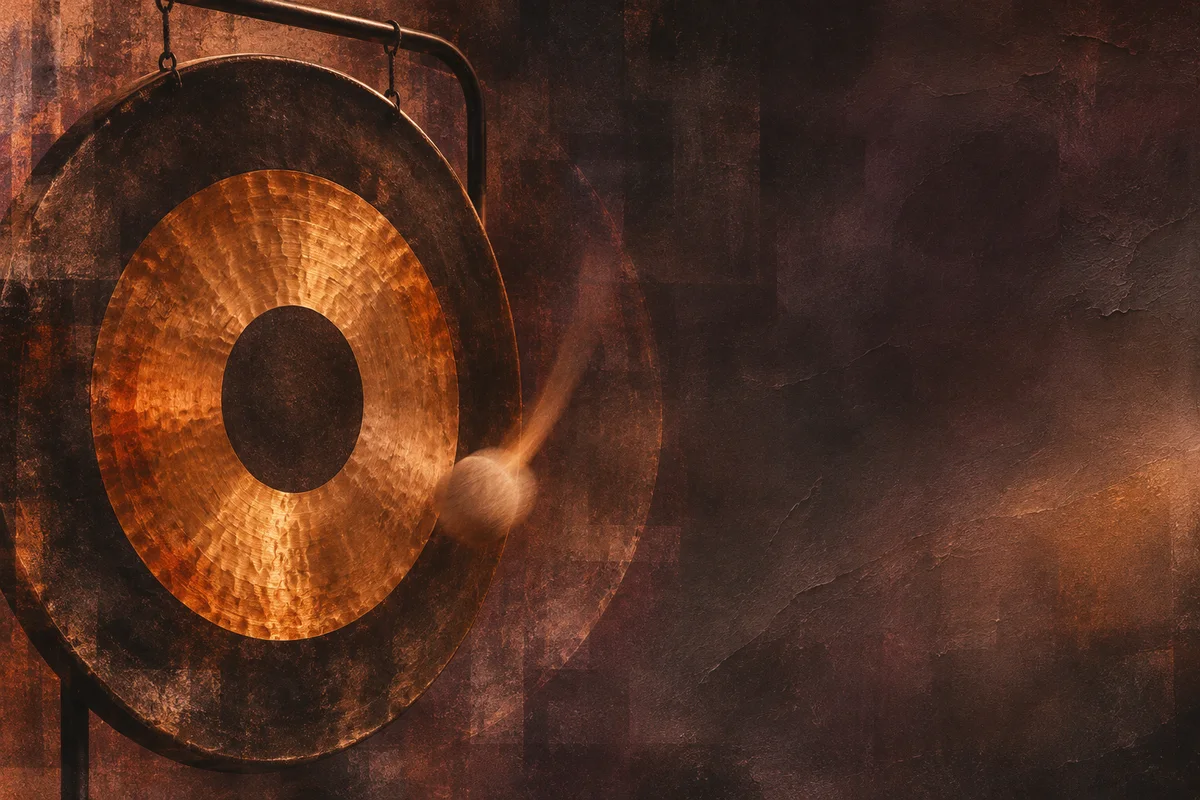
04 / Gong & silence
Let the Sound End.
The gong fills the room for about a minute. Then it fades, and we sit with the silence it leaves behind.
I give that silence some space before the next part begins. There’s something I want people to notice in the change from a full sound to the quiet after it.
Why I begin this way
Quiet Has a Context.
This is one of the ideas behind my method: when we hear the noise we usually ignore, the quiet afterward has a point of comparison. I want that awareness to come with you when you leave.
05 / Imagination & possibility
What Else
Is Possible?
Orchestral tones break the silence and introduce ambient music centered around F-sharp.
The guidance asks us to explore our imagination: what we carry from the past, what we’re ready to loosen our hold on, and what else might be possible.
I want people to feel that they have room to imagine again. That’s the intention behind this part of the work.
About the Language and Music
I’ve described my language here as NLP-like. In this passage, that means using guided imagery and open questions to explore what you’ve carried from the past and what you might imagine doing differently. You can take a question as an invitation to see what comes to mind.
The orchestral tones mark the return of music after the silence. I built the ambient passage around F-sharp as a compositional choice. You can stay with the music alone, let an image form, or leave the question open.

A moment to explore
What Comes
to Mind?
A picture, a thought, something you feel—or simply the sound of the music. There isn’t one way this has to look.
Choose one to explore. Nothing is recorded or saved.
You can be curious without needing an answer.

06 / Ocean & body awareness
Back to the Body
The words and music fade into ocean sounds.
After all that imagining, I bring the focus back to something immediate: the movement of a breath, the weight of the body, the room around us.
This is the transition into the next breathing passage.
If looking inward doesn’t feel right, you can keep your eyes open and stay with the room around you.
07 / Chakra-informed breathing
Breathing Through
the Chakras
In this part of the group session, I use a chakra-informed sequence to guide attention through the body. I spend about a minute at each point.
This is my own interpretation, shaped by years of practice. It’s a spiritual part of my work, and I use the language of energy to give attention a direction.
You can follow the imagery or stay with your natural breath.
About the Framework
In my practice, each chakra gives attention a place to rest. As the sequence moves from one point to the next, I give you time to notice your breath and what you feel in that part of the body. I use the language of energy to guide where you place your attention.
The sequence has its own pace. Your breathing can keep yours. You can follow the imagery, stay with one area, or simply listen to the sound. When the orchestral music returns, I let it carry us into the final part of the session.
I developed this interpretation through years of practice. It draws on chakra imagery with roots in South Asian contemplative traditions. In some Kaula Tantric texts, for example, practitioners visualize Kuṇḍalinī rising through a series of cakras.
Read James Mallinson on the history of yogic traditions at the Smithsonian

08 / Orchestral return
The Music Comes Back.
The orchestral flow returns as the composed sequence comes to a close.
I bring that familiar sound back before we finish together with live violin.

09 / Live violin
I Close With
Live Violin.
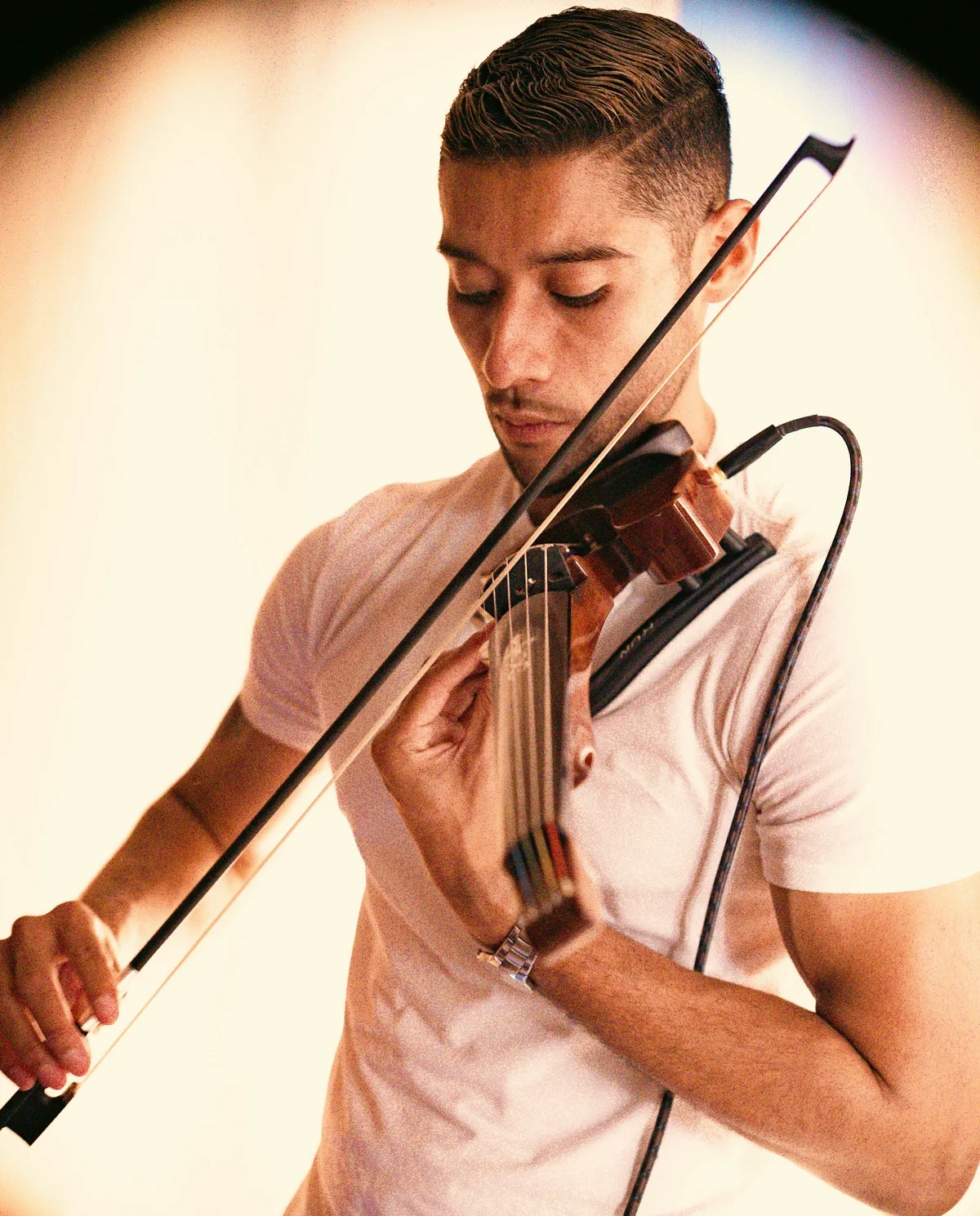
The practice ends with me playing violin, there in the room with everyone.
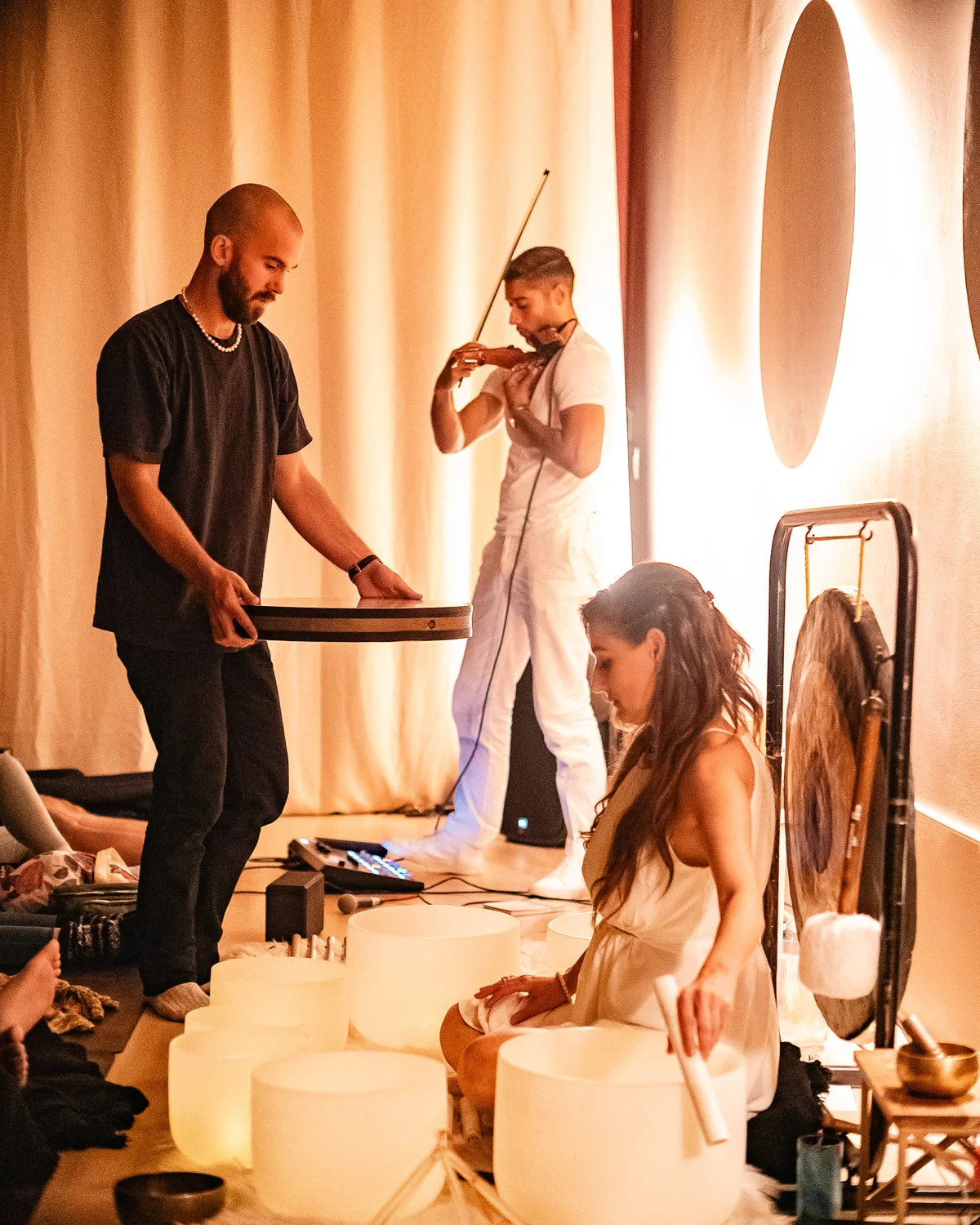
Live instruments are part of the session throughout. I compose the sequence ahead of time, then bring live playing into it.
For a group arriving from different places, that shared sequence is the structure I choose. In a one-to-one session, I have more room to understand where someone is and adapt the work around them.
How the parts belong together
The Recording
and the Room
The recording
- Noise & breath
- Dialogue & silence
- Imagination & body
- Orchestral return
In the room
Beyond the session / Waveshift
The Waves Continue.
The Baseline Can Change.
The highs and lows still happen. What interests me is how the way we perceive and respond to life can change.
There was a time when a painful change could put me out of commission. Now, I notice that I can move through changes that once would have overwhelmed me with more steadiness and more love toward myself. I still feel them. But how I respond—and how I care for myself through the transition—has changed.
What once felt like an exceptional moment of being able to handle life has started to feel more normal. That’s the idea behind Waveshift: the waves continue, but the baseline we experience them from can change.
What Once Felt Exceptional.
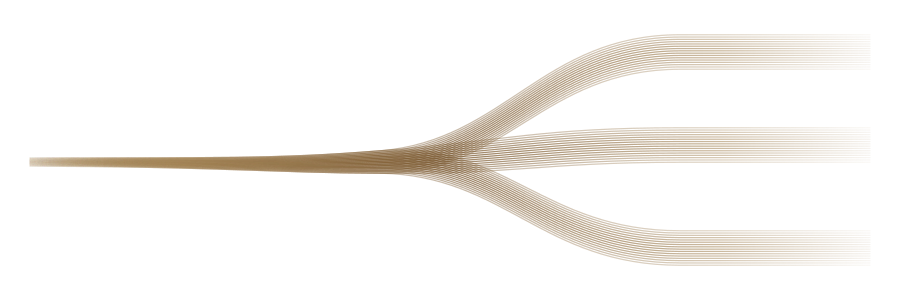
The dotted guide connects an earlier peak with the later baseline. My theory is that a way of meeting life that once felt exceptional can become more familiar. The waves still rise and fall around that changing baseline; the shift is in how we perceive and respond.
What if that space to reflect and respond became more available in everyday life?
Sound is a stepping stone to silence in my practice. Waveshift is the possibility I’m exploring beyond it: carrying that room to reflect into how we meet life, including its difficult changes.
Integration / Beyond the room
What Do You
Take With You?
A feeling during a session is one thing. Finding a place for it in your life is another.
That’s what I mean by integration. Write something down. Talk it through. Make something from it. Or give yourself time and see what stays with you.
- 01Notice
What caught your attention? A sound, a thought, a feeling?
- 02Reflect
Put a few words around it—in a journal, a voice note or a conversation.
- 03Choose
Is there one small thing you want to do with it? That might be making time to rest.
- 04Return
Come back to it later. Does it still feel useful? Has anything changed?
Taking it beyond the room
What Do You Hear Now?
When you leave, listen to the world around you for a moment. What do you notice?
The traffic, a conversation, the space between sounds. I want that opening passage to give you something to recognize in your own life.
I want people to leave with more than a memory of beautiful sound. I want them to have something to keep exploring. That’s why I bring the composed sequence, guided reflection and live playing together in this work.
Photography: @3rdeyechey
For a closer look
A Little More
About the Ideas
This essay brings together how I compose a session, the spiritual language I use, and the questions I’m exploring. These notes explain where those ideas come from and what is still open.
The Binaural-Beat Layer
I use a changing beat rate as part of the composition. When I refer to a beta-to-theta progression here, I’m describing how I designed the audio layer. A change in the recording is something I can specify. A change in a listener’s brain would need to be measured.
A 2017 experiment found no significant enhancement in the EEG bands it tested and no significant changes in its heart rate or skin conductance measures. A 2020 experiment found auditory responses and differences in brain connectivity. It found no evidence of mood changes under its conditions.
López-Caballero & Escera, 2017
Orozco Perez, Dumas & Lehmann, 2020
What I’d Like to Understand Better
I’m curious about what the opening changes in the act of listening. If the same sequence began in quiet, would the gong’s fade feel different? Would you notice the traffic or the room differently afterward?
Someone’s account could tell me what stood out to them. To learn whether the opening made a difference, I’d need to compare versions that differed at the opening and decide in advance what I wanted to observe. The question comes from how I compose the session, and I’m still exploring it.
Cultural Context for the Chakra-Informed Passage
In his Smithsonian essay, historian James Mallinson traces how techniques passed between distinct yogic traditions. He describes some Kaula Tantric texts in which practitioners visualize Kuṇḍalinī rising through a series of cakras, or wheels, along the body.
That history gives context to the imagery in this passage. The sequence I use in the room grew out of my own years of practice. Its cues give listeners a place to bring their attention during this part of the composition.
Taking Part at Your Own Pace
If you play the excerpt, start at a comfortable low volume and listen somewhere you can give it your attention. You can pause when the sound feels intense, skip to the next passage, or read the essay in silence.
If you try one of the invitations, keep your eyes open or change position whenever you like. Let your breath return to its usual rhythm. With imagery or reflection, you can notice what comes up and leave it there. Listening alone is a way to take part.
What I Mean by “Theory”
Waveshift gives me a way to think about the difference between what I feel today and what starts to feel familiar over time. The line in the diagram represents that changing reference point. A difficult day can still feel difficult even when my way of meeting it has changed.
I’m exploring whether the space to notice and respond can carry beyond a session. The diagram gives me a way to ask that question. The inner-child and imagination passages work as invitations to reflect. If an image or feeling comes up, you can notice it without treating it as evidence that an event happened.